A product beside a window may have an attractive bright side and a shaded side that loses important detail. Before adding another lamp, try a plain white card. It gives you a simple way to change the balance while keeping the original direction of light. The useful adjustment is usually the card’s position rather than its size alone.
Begin with one unchanged frame
Place the product where its main shape and label are visible. Take a photograph without the card and keep it as your reference. Identify the shadow you want to change: it might be a handle, a dark side panel or the underside of an edge. Avoid trying to brighten every shaded area equally. Some shadow gives the object form, and the reference frame helps you see whether the card improves readability or simply makes everything flatter.
Move the card into the useful path
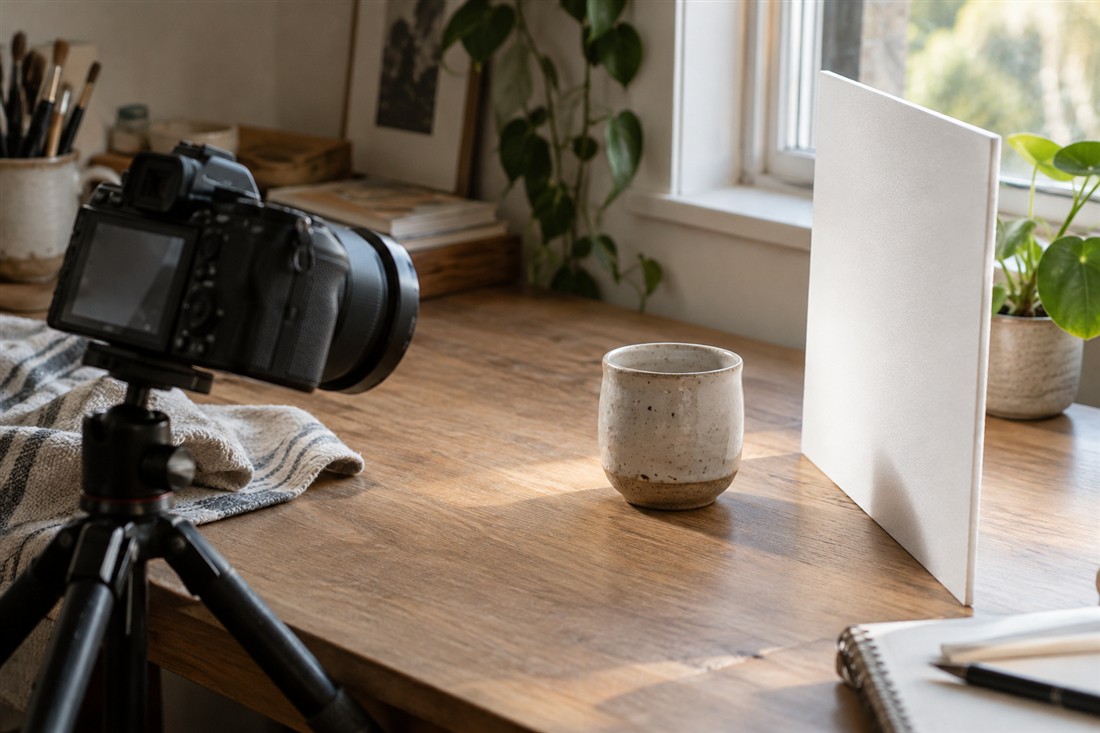
Put a clean, matte white card on the shaded side, outside the frame. Angle it toward the product and move it closer in small steps. Watch the selected detail rather than just the overall screen brightness. If there is little change, alter the angle and check whether the card receives useful light.
Support the card securely. A folded piece may stand on a table, but do not balance it where it can fall onto a delicate product or obstruct movement around equipment.
Check reflections as well as shadows
On a glossy object, the card may appear as a new pale reflection. That can help describe a curve, or it may cover a label you need to show. Rotate or reposition the card until its reflection supports the shape. A very large card placed close to the object changes more than a small distant one, so compare actual frames. Keep the camera and product steady while you work so you are assessing one change at a time.
Keep a repeatable arrangement
Once the balance is useful, record where the card stood relative to the product and window. Photograph the setup from the side for your own working notes. Check again if sunlight shifts, cloud cover changes or you replace the object with a darker finish. A card has no independent output to hold constant; its contribution depends on the light reaching it. Reusing the same physical position is a starting point, not a guarantee of an identical result.
Keep the version where shadow detail is clearer but the product still has shape. A white card is useful because you can understand and reverse its effect quickly. Start from the reference, move it deliberately and stop when it solves the specific shadow you identified.